
A restaurant's sound brief can follow the rhythm of service: arrival, dining, the bar and a change in energy later in the evening. Agree those needs with the operator and give staff controls that make the intended transitions practical.
The Acoustic Challenge of Dining
Dining environments contain multiple competing sound sources:
- Conversation
- Service movement
- Glassware
- Open kitchens
- Music
Without careful strategy, these elements accumulate into fatigue.
Restaurant sound design is not about volume. It is about balance.
Consistency within a zone, purpose across zones
A zone can need consistent playback while neighbouring zones have distinct functions and settings. Independent control provides operating flexibility; it does not create physical isolation. Plan open boundaries, private rooms and transmission questions separately.
Source: FIS (2021), Ceilings and Acoustic Absorbers, hosted by Rockfon
Design the handovers before they are needed
Agree the audio states with the operator: sources, active areas, level relationships and who can change them. Test the intended transitions during commissioning and document the staff controls. A preset is a repeatable operating choice, not a licence to increase level or a proof that sound will stay within a building limit.
One system. Several functions.
Illustrative venueAt concept design the venue is a plan: walls, openings and furniture. This is the point to design the audio, while ceilings, joinery and services can still move.
- Stage
- RIBA Stage 2
- Drawings
- Plan and furniture layout
The installed system: loudspeakers, integrated subwoofers and acoustic treatment, coordinated with the architecture. Every operating state that follows runs on this same equipment.
- Sources
- Playlist and DJ
- Routing
- Either source to any room
Music sets the character of the room without leading it. Even coverage and consistent level matter more than output.
- Source
- Scheduled playlist
- Preset
- Background
- Control
- Automatic
A private room separates for a dinner, launch or speech, then returns to service, without the team needing to touch the technical system.
- Source
- Playlist, private room independent
- Preset
- Event
- Control
- Private room panel
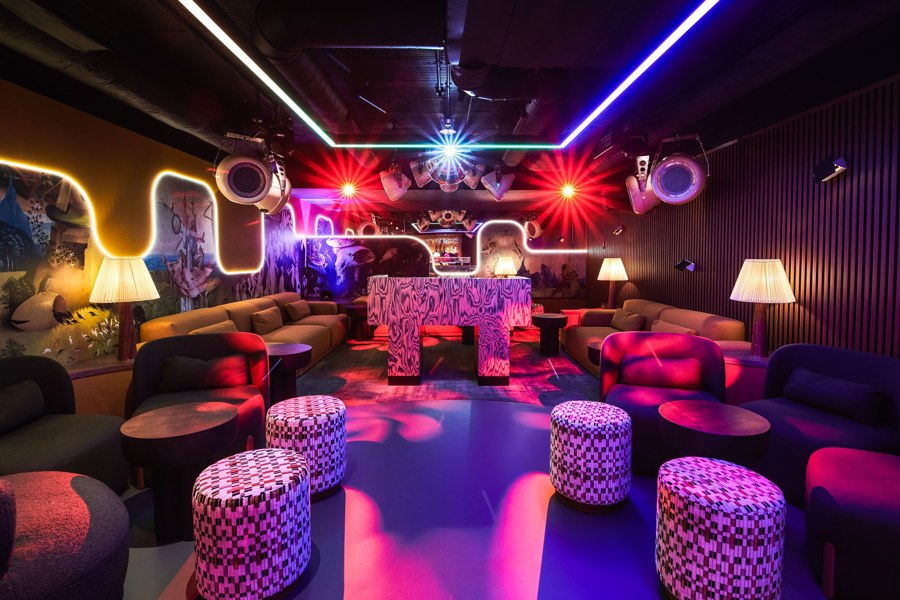
Where the brief calls for it, playback hands over to a DJ or live performer, with inputs, routing, monitoring and low-frequency support already designed in.
- Source
- DJ input, playlist off
- Preset
- Performance
- Control
- DJ or performer
Source
Active
Available, inactive
Speakers
Wall-mounted speaker
Integrated subwoofer
Bass trap
Coverage
Lower energyHigher energy
One system. Several functions.
Illustrative venueAt concept design the venue is a plan: walls, openings and furniture. This is the point to design the audio, while ceilings, joinery and services can still move.
- Stage
- RIBA Stage 2
- Drawings
- Plan and furniture layout
The installed system: loudspeakers, integrated subwoofers and acoustic treatment, coordinated with the architecture. Every operating state that follows runs on this same equipment.
- Sources
- Playlist and DJ
- Routing
- Either source to any room
Music sets the character of the room without leading it. Even coverage and consistent level matter more than output.
- Source
- Scheduled playlist
- Preset
- Background
- Control
- Automatic
A private room separates for a dinner, launch or speech, then returns to service, without the team needing to touch the technical system.
- Source
- Playlist, private room independent
- Preset
- Event
- Control
- Private room panel
Where the brief calls for it, playback hands over to a DJ or live performer, with inputs, routing, monitoring and low-frequency support already designed in.
- Source
- DJ input, playlist off
- Preset
- Performance
- Control
- DJ or performer
Source
Active
Available, inactive
Speakers
Wall-mounted speaker
Integrated subwoofer
Bass trap
Coverage
Lower energyHigher energy
One system. Several functions.
Illustrative venueAt concept design the venue is a plan: walls, openings and furniture. This is the point to design the audio, while ceilings, joinery and services can still move.
- Stage
- RIBA Stage 2
- Drawings
- Plan and furniture layout
The installed system: loudspeakers, integrated subwoofers and acoustic treatment, coordinated with the architecture. Every operating state that follows runs on this same equipment.
- Sources
- Playlist and DJ
- Routing
- Either source to any room
Music sets the character of the room without leading it. Even coverage and consistent level matter more than output.
- Source
- Scheduled playlist
- Preset
- Background
- Control
- Automatic
A private room separates for a dinner, launch or speech, then returns to service, without the team needing to touch the technical system.
- Source
- Playlist, private room independent
- Preset
- Event
- Control
- Private room panel
Where the brief calls for it, playback hands over to a DJ or live performer, with inputs, routing, monitoring and low-frequency support already designed in.
- Source
- DJ input, playlist off
- Preset
- Performance
- Control
- DJ or performer
Source
Active
Available, inactive
Speakers
Wall-mounted speaker
Integrated subwoofer
Bass trap
Coverage
Lower energyHigher energy
Supporting Service Rhythm
Sound influences:
- Pace of dining
- Perceived privacy
- Guest dwell time
- Emotional tone
When aligned with service choreography, audio becomes a subtle tool that enhances the overall experience.
When misaligned, it introduces friction.
Integrating with Architecture

Restaurants are often material expressive environments.
Audio hardware must respect ceiling detail, joinery, and lighting composition.
Early coordination ensures:
- Balanced coverage
- Reduced visual intrusion
- Predictable performance
Late coordination leads to compromise.
From Equipment to Experience
Restaurant sound design is frequently reduced to equipment selection.
The more important task is defining:
- Sonic intent
- Spatial hierarchy
- Operational clarity
Equipment follows.
A Strategic Advantage
Restaurants compete not only on cuisine but on atmosphere.
A considered sonic strategy enhances conversation, comfort, and energy without overwhelming the space.
If you are developing a dining concept or refining an existing venue, defining the sonic layer early will protect both architecture and service.

