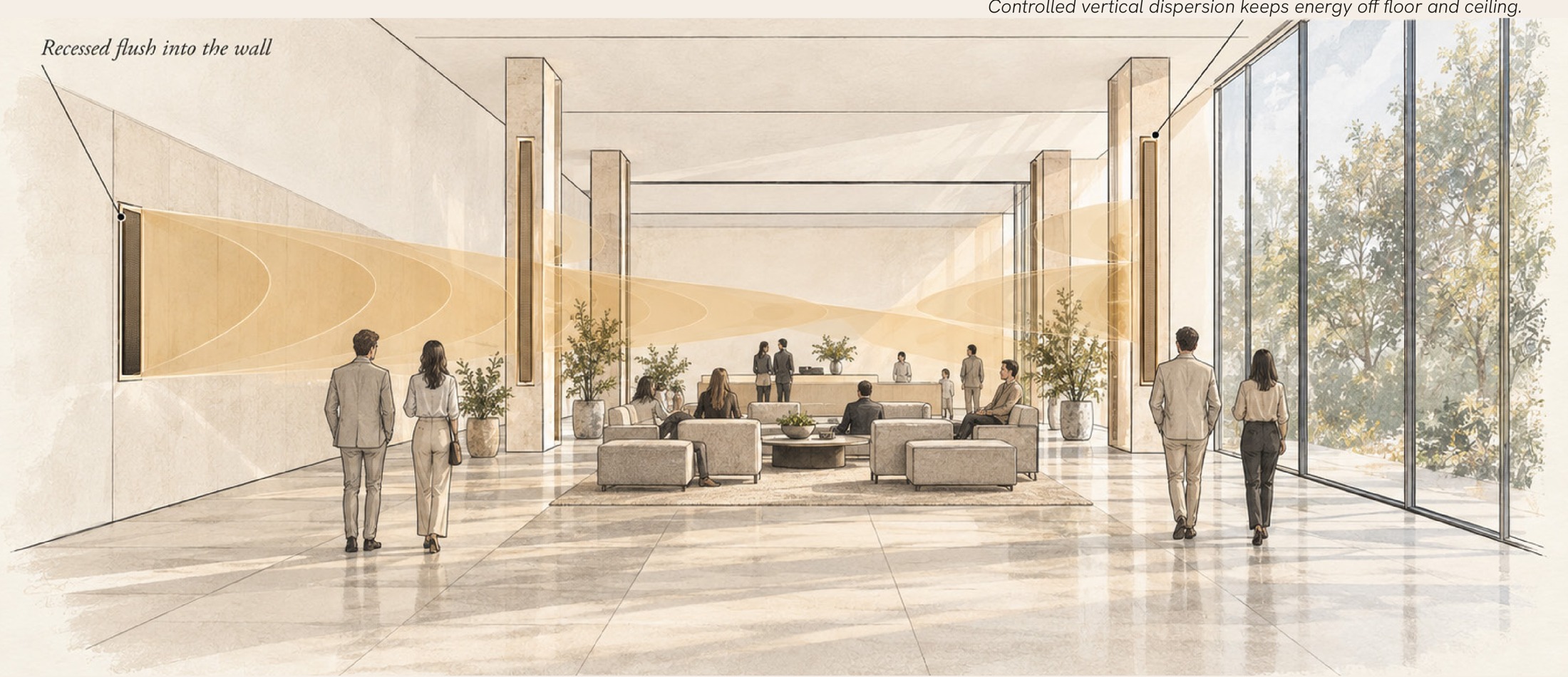
Concept design is a useful time to agree what sound needs to do for the operator. The project team can consider speaker locations, visual presence, infrastructure and staff control together, while keeping options open as the design develops.
Why Audio Decisions Drift Late
In hospitality and premium residential projects, early design stages prioritise form, programme, and material expression. Audio is often treated as a technical layer that can be integrated later.
This creates predictable friction:
- Speaker positions conflict with ceiling geometry
- Visible hardware disrupts minimalist interiors
- Coverage becomes inconsistent across zones
- Control systems become operationally complex
These are not technical failures. They are sequencing failures.
Sound should be considered at the same moment sightlines and material transitions are defined.
Sound as a Spatial Condition
Sound is not simply a system. It is a spatial condition.
Every room has:
- A volume
- A material palette
- A circulation pattern
- A behavioural intention
Audio strategy must respond directly to these factors.
In a lobby, the intention may be arrival and orientation. In a dining space, it may be intimacy and conversation. In a gallery, clarity and restraint.
When sound is treated as equipment, these distinctions disappear. When sound is treated as spatial strategy, they become explicit.
Use the current RIBA stage names
RIBA’s 2020 plan names Stage 2 Concept Design, Stage 3 Spatial Coordination and Stage 4 Technical Design. Agree the broad listening and operating brief at concept where possible, coordinate locations and routes as the spatial design develops, and resolve the technical documentation for delivery.
These activities are SDS’s project recommendations, not a required appointment sequence. A later-stage project should be reviewed against its actual remaining options.
Source: RIBA Plan of Work 2020 template
One system. Several functions.
Illustrative venueAt concept design the venue is a plan: walls, openings and furniture. This is the point to design the audio, while ceilings, joinery and services can still move.
- Stage
- RIBA Stage 2
- Drawings
- Plan and furniture layout
The installed system: loudspeakers, integrated subwoofers and acoustic treatment, coordinated with the architecture. Every operating state that follows runs on this same equipment.
- Sources
- Playlist and DJ
- Routing
- Either source to any room
Music sets the character of the room without leading it. Even coverage and consistent level matter more than output.
- Source
- Scheduled playlist
- Preset
- Background
- Control
- Automatic
A private room separates for a dinner, launch or speech, then returns to service, without the team needing to touch the technical system.
- Source
- Playlist, private room independent
- Preset
- Event
- Control
- Private room panel
Where the brief calls for it, playback hands over to a DJ or live performer, with inputs, routing, monitoring and low-frequency support already designed in.
- Source
- DJ input, playlist off
- Preset
- Performance
- Control
- DJ or performer
Source
Active
Available, inactive
Speakers
Wall-mounted speaker
Integrated subwoofer
Bass trap
Coverage
Lower energyHigher energy
Concept Stage
- Define sonic intent
- Identify zone logic
- Map high level coverage strategy
- Flag ceiling and coordination risks
Developed Design
- Integrate speaker strategy with lighting and MEP
- Refine zoning hierarchy
- Define performance criteria
Technical Design
- Finalise specification
- Coordinate with delivery partners
- Protect architectural intent through documentation
When audio enters only at Stage 4 or later, design protection becomes damage control.
Coordinate ceilings, walls and intentional visibility
Equipment can be integrated into a scheme or deliberately visible. Review speaker positions, infrastructure, access and finishes with the other disciplines. Avoid assuming that visible equipment is always a compromise or that completed interiors offer no worthwhile improvement.
What Design Teams Gain

Selected work
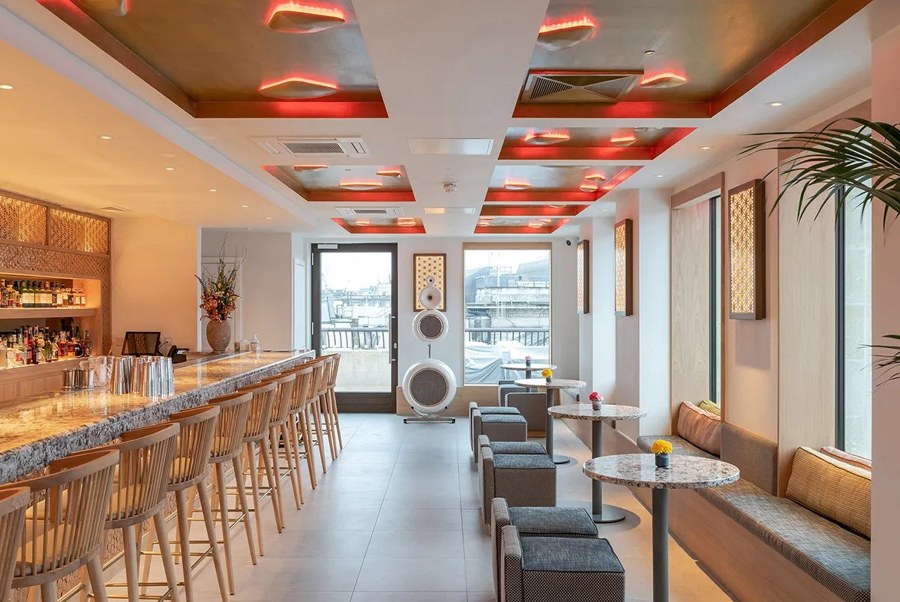
Bisushima
Architectural audio consultancy. Pequod Acoustics custom specification. Architecture by Ben Adams Architects.
As featured in Architecture Magazine
Engaging architectural audio consultancy at concept stage provides:
- Fewer late stage revisions
- Cleaner ceiling coordination
- Consistent coverage across zones
- Greater control over visual impact
- Reduced operational friction
Most importantly, it protects design integrity.
A Strategic Design Decision
Lighting designers are engaged early because light defines perception. Sound is equally powerful.
When considered early and executed precisely, it reinforces intent without drawing attention to itself.
For architects and interior designers working on hospitality, cultural, or premium residential projects, defining the sonic layer at concept stage is not an optional technical exercise. It is a design decision.


