
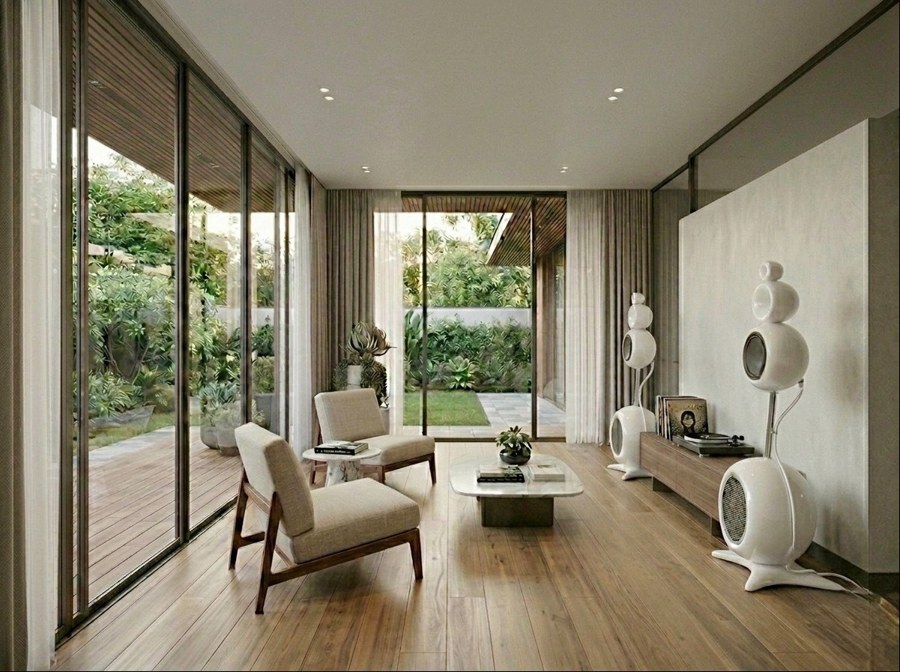
A private listening room starts with the way its owner wants to listen. SDS considers the room, seating, system and visual brief together, with either sculptural equipment or a more discreet installation where appropriate.
Why High-End Systems Underperform in Domestic Rooms
The performance of any audio system is determined as much by the room as by the equipment. This is true at every price point, but the effect becomes more visible as the system becomes more transparent. A modest system in a poor room sounds modest. A reference system in a poor room sounds modest, expensive, and frustrating.
The dominant factors are room geometry, surface behaviour and low-frequency response.
Room geometry determines where modes occur, the standing waves produced by the room’s dimensions. In rectangular rooms with parallel walls, modes pile up at specific frequencies, producing peaks and nulls that change as the listener moves around. A bass note that sits perfectly in one position will collapse two seats away. No equipment, however refined, can compensate for this.
Surface behaviour determines how early reflections reach the listener. Hard surfaces close to the loudspeakers, particularly side walls, front walls and ceilings, produce reflections that arrive within milliseconds of the direct sound, smearing the stereo image and reducing the precision the system was designed to deliver.
Low-frequency response is the most demanding of the three. Bass energy interacts with the room over long wavelengths and is the hardest to control without architectural intervention. Loudspeakers can be excellent. Amplifiers can be excellent. If the room is not built to manage low-frequency behaviour, the result is bloom, slowness and a loss of definition that no signal processing can fully resolve.
Develop the room and system around the way you listen
Agree seating, music, desired playback, visual presence and whether the room is dedicated or shared. Review speaker positions, room boundaries and possible construction or treatment choices together. Calibration can mitigate aspects of room response; it does not remove the need to consider physical layout and treatment.
Source: Genelec, Calibration and acoustics
- Architecture
- Joinery & ceilings
- Audio
- Infrastructure
Keep playback, treatment and isolation distinct
A private room does not need to imitate a studio control room, but there is no reason to dismiss studios as places that cannot support musical pleasure. Non-parallel walls do not establish that a room has no modal behaviour. Floating floors and isolated walls concern transmission and require the appropriate specialist design; they are not a general substitute for internal acoustic treatment.
Source: FIS (2021), Ceilings and Acoustic Absorbers, hosted by Rockfon
How This Integrates Into a Renovation
The most useful moment to address a listening room is during a wider renovation or new-build project. At that stage, the wall build-ups, floor build-ups, ceiling structure and service routes are all in play. Acoustic decisions can be made within the building fabric rather than added to the surface.
In our residential work, the listening room is approached as a sub-project within the wider house. It is briefed alongside the rest of the interior, designed in coordination with the architect and interior designer, and built into the construction package. The integration team commissions the room after fit-out and tunes the system to the room as built.
The clients who get the most from this approach are usually those who have moved beyond product collecting. The equipment is not the variable they are still trying to optimise. The room is.
What to Have Ready Before the First Conversation

Selected work
Private Residence
Architectural audio consultancy. Bowers & Wilkins, Devialet and Pequod Acoustics integrations.
A few useful pieces of information shape the early stages.
The intended use. Two-channel listening, multi-channel reproduction, occasional live recording, or a combination.
The musical priority. Whether the system needs to perform best at moderate, late evening volumes, or at higher levels.
The architectural context. Whether the room is a dedicated build, a substantial conversion, or a defined room within a wider renovation.
The integration sensitivity. How visible any of the equipment is allowed to be, and how the room should read when not in use.
These conversations resolve quickly when had at the right stage. They become more constrained the later they are had.
The Right Partner
Sonic Design Studios works with private clients, architects and interior designers on dedicated listening environments and integrated residential audio across London and beyond. Our approach treats the room as the instrument and the equipment as the means by which it is played.
If you are renovating, building, or considering a dedicated listening space, the most valuable conversation is the one had before the wall build-ups are finalised. Book a residential consultation.


