
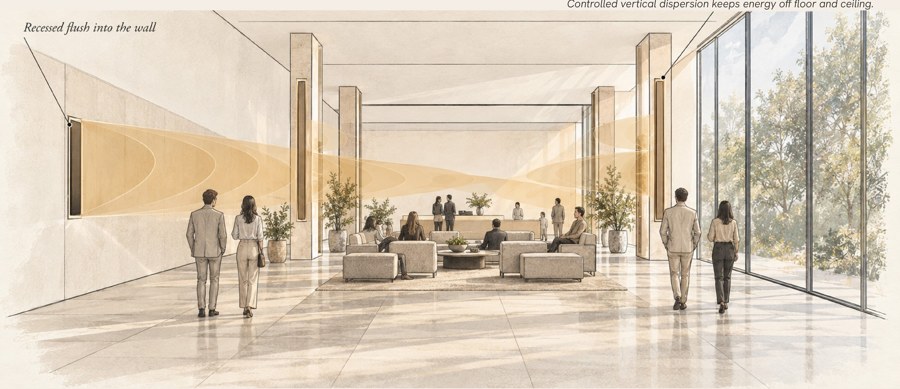
A useful audio brief starts with how the venue will operate: who uses each space, what they need to hear and how its atmosphere changes through the day. Architects and audio designers can then coordinate the system with the room, whether speakers are discreetly integrated or deliberately visible.
Where sound does its best work
Sound is most rewarding to design while the room is still taking shape. At concept stage the question we ask is simple. What should this space feel like at each point in its day? The technical strategy follows from the answer.
When we are in early, loudspeaker positions are chosen for even coverage, cable routes sit cleanly within the service zones, and equipment locations are agreed before the joinery package goes out, so racks and amplifiers are sized into spaces that ventilate properly. Acoustic treatment becomes part of the material palette rather than an addition to it. If a ceiling needs to perform acoustically, that is built into the ceiling. If joinery needs to absorb energy, the detail accommodates it.
The outcome is a finished space where the audio belongs to the room, whether the loudspeakers are discreetly integrated or chosen as deliberate, sculptural objects. Either way, nothing in the finish is left to chance, the atmosphere matches the design intent, and the engineering is resolved rather than hidden for its own sake.
Coordinating the brief through the project
At Concept Design, agree the venue uses, the visual role of equipment and the broad system approach. Spatial Coordination develops locations and routes alongside the rest of the team. Technical Design resolves the specification and installation details. During delivery and handover, check the installed system, commissioning and staff controls against the brief.
These are SDS coordination recommendations. They do not imply that RIBA requires an audio appointment at a particular stage. Early discussion can preserve options; an existing or later-stage project starts with the options it still has.
Source: RIBA Plan of Work 2020 template
One system. Several functions.
Illustrative venueAt concept design the venue is a plan: walls, openings and furniture. This is the point to design the audio, while ceilings, joinery and services can still move.
- Stage
- RIBA Stage 2
- Drawings
- Plan and furniture layout
The installed system: loudspeakers, integrated subwoofers and acoustic treatment, coordinated with the architecture. Every operating state that follows runs on this same equipment.
- Sources
- Playlist and DJ
- Routing
- Either source to any room
Music sets the character of the room without leading it. Even coverage and consistent level matter more than output.
- Source
- Scheduled playlist
- Preset
- Background
- Control
- Automatic
A private room separates for a dinner, launch or speech, then returns to service, without the team needing to touch the technical system.
- Source
- Playlist, private room independent
- Preset
- Event
- Control
- Private room panel
Where the brief calls for it, playback hands over to a DJ or live performer, with inputs, routing, monitoring and low-frequency support already designed in.
- Source
- DJ input, playlist off
- Preset
- Performance
- Control
- DJ or performer
Source
Active
Available, inactive
Speakers
Wall-mounted speaker
Integrated subwoofer
Bass trap
Coverage
Lower energyHigher energy
Stage 2, Concept Design
We work with the architect and interior designer to define the sonic intent of each space: mood, programming, zoning, control philosophy and the level of integration required. At this stage we are not specifying products. We are defining how each room should behave.
Stage 3, Spatial Coordination
Loudspeaker strategy is overlaid onto the spatial coordination. Speaker types and positions are agreed in dialogue with the ceiling and lighting layout, and acoustic priorities are identified: which surfaces should absorb, which can reflect, where treatment is built into joinery and where it is expressed.
Stage 4, Technical Design
System architecture is documented. Cable routes, equipment racks, control points and power requirements are coordinated with M&E, and acoustic treatment is detailed within the wall, ceiling and joinery packages so it sits inside the finishes.
Stage 5, Manufacturing and Construction
We support the integration team through installation, commissioning and tuning. Coverage is verified, the system is calibrated against the room as built, and control interfaces are set up for the way the venue actually runs.
A brief that joins operation and design
The operator describes service, events, musical intent and staff control. The architect and interior designer coordinate equipment with the spatial and material scheme. SDS develops the audio system and the acoustic considerations that inform it, with specialist input where formal assessment is required. Speakers may be deliberately visible or discreetly integrated.
When to bring us in

Selected work
Bisushima
Architectural audio consultancy. Pequod Acoustics custom specification. Architecture by Ben Adams Architects.
As featured in Architecture Magazine
The most useful moment is while the ceiling plan is still flexible, around RIBA Stage 2. That said, we regularly join later projects and work within whatever the programme allows. An early engagement gives us the most to work with, and we are equally happy picking up a scheme further along and making the most of it.
Working with us
At Sonic Design Studios we look after the sonic layer for architects, interior designers, hospitality operators and private clients, from concept through to commissioning. Our approach is set out in The Architect’s Guide to Specifying Audio Systems, a practical reference for design teams.
If sound matters on your current project, the most useful conversation is the earliest one. Book a consultation.


