
Atmosphere is an operating priority because it is part of what guests experience. Audio can be planned and evaluated alongside light, layout and service, with commercial outcomes assessed in the venue rather than promised in advance.
Make sound part of the operating brief
Define how conversation, music and service should coexist in each area and operating state. Review the places and times where the present system does not support that brief. There is no verified 70–78 dBA point at which a venue’s dwell time necessarily collapses. Treat guest and staff feedback as evidence to investigate, not as a universal threshold or a revenue forecast.
One system. Several functions.
Illustrative venueAt concept design the venue is a plan: walls, openings and furniture. This is the point to design the audio, while ceilings, joinery and services can still move.
- Stage
- RIBA Stage 2
- Drawings
- Plan and furniture layout
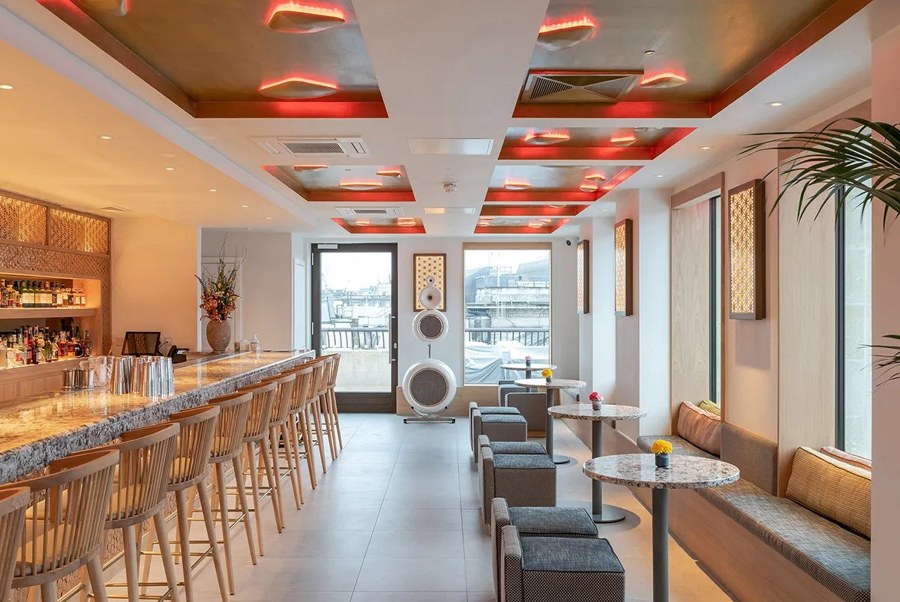
The installed system: loudspeakers, integrated subwoofers and acoustic treatment, coordinated with the architecture. Every operating state that follows runs on this same equipment.
- Sources
- Playlist and DJ
- Routing
- Either source to any room
Music sets the character of the room without leading it. Even coverage and consistent level matter more than output.
- Source
- Scheduled playlist
- Preset
- Background
- Control
- Automatic
A private room separates for a dinner, launch or speech, then returns to service, without the team needing to touch the technical system.
- Source
- Playlist, private room independent
- Preset
- Event
- Control
- Private room panel
Where the brief calls for it, playback hands over to a DJ or live performer, with inputs, routing, monitoring and low-frequency support already designed in.
- Source
- DJ input, playlist off
- Preset
- Performance
- Control
- DJ or performer
Source
Active
Available, inactive
Speakers
Wall-mounted speaker
Integrated subwoofer
Bass trap
Coverage
Lower energyHigher energy
One system. Several functions.
Illustrative venueAt concept design the venue is a plan: walls, openings and furniture. This is the point to design the audio, while ceilings, joinery and services can still move.
- Stage
- RIBA Stage 2
- Drawings
- Plan and furniture layout
The installed system: loudspeakers, integrated subwoofers and acoustic treatment, coordinated with the architecture. Every operating state that follows runs on this same equipment.
- Sources
- Playlist and DJ
- Routing
- Either source to any room
Music sets the character of the room without leading it. Even coverage and consistent level matter more than output.
- Source
- Scheduled playlist
- Preset
- Background
- Control
- Automatic
A private room separates for a dinner, launch or speech, then returns to service, without the team needing to touch the technical system.
- Source
- Playlist, private room independent
- Preset
- Event
- Control
- Private room panel
Where the brief calls for it, playback hands over to a DJ or live performer, with inputs, routing, monitoring and low-frequency support already designed in.
- Source
- DJ input, playlist off
- Preset
- Performance
- Control
- DJ or performer
Source
Active
Available, inactive
Speakers
Wall-mounted speaker
Integrated subwoofer
Bass trap
Coverage
Lower energyHigher energy
Why Most Venues Treat Sound as a Finishing Layer
The reason is structural. Audio is the last discipline to be brought into the project, often after the operator’s brand standards have been finalised and the interior is in fabrication. By the time anyone is making a sound decision, the budget is constrained, the ceiling void is committed, and the available scope is essentially: which speakers will fit, and which playlist service will we subscribe to.
This is not a question that produces atmosphere. It is a question that produces minimum viable audio.
Operators who treat sound as part of the operating model, rather than the closing layer of the fit-out, make different decisions. Sound is briefed at the same time as the interior. The acoustic environment is shaped during architectural design rather than corrected afterwards. The music programme is developed in dialogue with the operations team rather than handed to a streaming service. The system is specified for the room and the brand, not selected from a catalogue.
The cost difference, in our experience, is rarely significant at this level of project. The outcome difference is substantial.
The Three Layers of a Hospitality Sound Strategy
Layer One - Acoustic Environment
This is the room itself. It is determined by architecture, geometry and material choice. It cannot be substituted for by audio equipment. Hard, energy-dense rooms will sound loud, fatiguing and uncomfortable regardless of the sound system specified. Acoustic strategy belongs in the architectural brief.
A useful test: at full occupancy, does the room remain comfortable for conversation at the table, or does it tip into guests raising their voices to be heard? There is no universal number for where that happens; it depends on the venue type, the concept and how the room is used, which is why we judge it in the room rather than against a fixed figure.
For more on the acoustic side specifically, see our piece on restaurant acoustics in London.
Layer Two - Music Programme
The programme is the emotional script of the space. It is what guides the venue through its operating arc, calm at opening, building through service, peaking at the right point, settling back at close. It is content, not infrastructure, and it should be developed with the operator’s brand and service rhythm in mind.
The most common failure here is a static playlist that does not move with the room. The second most common is a programme that is correctly designed but unevenly delivered, because the system cannot reproduce it properly at the volumes required.
Layer Three - System Design
The system is the instrument that delivers the programme into the acoustic environment. It includes loudspeaker types and positions, amplification, signal processing, zoning, and control logic.
A well designed system delivers even coverage, appropriate volume at every position, clean low-frequency response without unwanted resonance, and independent control across zones. A poorly designed system produces hotspots, dead zones, harshness at higher volumes, and inconsistent atmosphere across the venue.
What This Looks Like in Practice

In our hospitality work, the most consistent intervention is bringing the operator’s brand intent and the architectural intent into dialogue at the point where the audio is specified.
A venue concept that is intimate and conversational requires a different acoustic environment, a different music programme and a different system from one that is high-energy and music-led. These are not interchangeable. The audio strategy follows from the brand intent, not the other way round.
Where this is done well, the audio layer becomes one of the most consistent commercial assets the venue has. It produces a feeling that guests cannot quite identify but consistently return for. It supports the service team rather than fighting them. It evolves through the day in a way that matches how the venue is actually being used.
Where it is done poorly, it produces the recognisable hospitality failure mode, a beautifully designed room that sounds loud, generic or off-brand, and that under performs against its visual ambition.
Agree responsibility, scope and review criteria
The useful commission resolves a defined set of audio decisions with the operator and design team. It may be design only, design and supply or a wider delivery scope. Where formal acoustic or statutory work is needed, coordinate the relevant specialist. Set review criteria before the intervention, and assess any commercial outcome with its limitations.


