
A London venue's acoustic needs depend on its room, neighbours and operating pattern. SDS helps define the audio system brief and coordinates with specialist acoustic consultants where room or building performance requires formal assessment.
Why Restaurant Acoustics Matter
How a room sounds is part of the experience an operator is offering. Research on restaurant soundscapes links the overall sound of a room to how diners rate their visit. It does not show that an acoustic change reliably increases length of stay or spend, so we treat those as questions to test in the venue rather than promises.
Source: Steffens, Wilczek and Weinzierl (2021), The Soundscape of Restaurants. Frontiers in Built Environment
The Real Cause of Loud Restaurants
Most restaurant noise problems are not caused by music or crowd size. They are caused by the space itself.
Common design choices in modern hospitality spaces include concrete and brick surfaces, glass and steel finishes, polished stone flooring, and open ceilings.
These materials reflect sound, creating a build-up of noise as occupancy increases.
This triggers the Lombard effect, where guests raise their voices to be heard, increasing noise levels even further.
Without proper acoustic treatment in restaurants, this cycle cannot be controlled.
What is less obvious is that a loud room can also change how people report the taste of food. Controlled experiments have found that background noise can change how people report the taste of food. Those findings do not set a universal sound level for restaurants, and they do not predict what guests will spend.
Source: Woods et al. (2011), Effect of background noise on food perception. Food Quality and Preference
Why Sound Systems Do Not Fix Acoustic Problems
A frequent mistake is relying on a sound system to solve noise issues.
Even high-end systems fail in acoustically untreated spaces because reflected sound reduces clarity, speech intelligibility drops, music becomes harsh and uncontrolled, and volume levels increase unnecessarily.
This is why restaurant sound system design must work alongside acoustic design, not replace it.
Why Most Restaurants Get It Wrong
The issue lies in project sequencing.
In most hospitality projects, interior design is finalised, materials are specified, the build is completed, and then acoustic consultants are brought in.
By this stage, meaningful acoustic optimisation is limited.
This leads to compromised solutions instead of integrated design.
What Professional Restaurant Acoustic Design Looks Like
Effective hospitality acoustic design creates control, not silence.
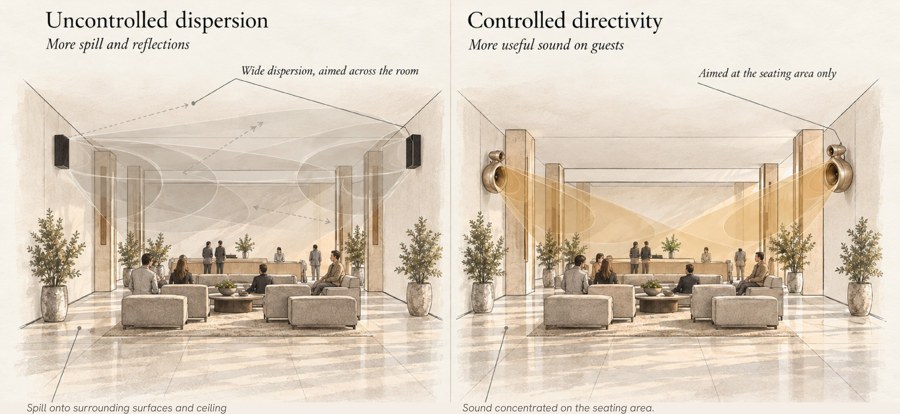
A properly designed space allows clear conversation at every table, even sound distribution across the room, controlled energy during peak hours, and seamless transition from day to night service.
This is achieved through acoustic material selection, strategic speaker placement, zoning and sound control, and early-stage acoustic modelling.
Absorption and the sound system do different jobs
Treatment and the audio system solve different problems, and both matter. Porous absorption reduces reflections and the build-up of noise; it is not the same as sound insulation, which stops sound travelling between spaces. Real performance comes from the exact tested build-up of a material, not its appearance. The specialist acoustic consultant leads on absorption and insulation; we design the sound system, zoning and loudspeaker placement to suit the room.
Source: FIS (2021), Ceilings and Acoustic Absorbers. FIS
How to Improve Restaurant Acoustics

Selected work
Claude's at Chotto Matte
Architectural audio consultancy. Custom loudspeaker integration. Interior design by Superfutures Design Studio.
As featured in Mondo-DR
To fix restaurant noise problems effectively, bring audio and acoustics in early through an architectural audio consultancy working with your acoustic consultant, align the brief with the interior design, specify materials with tested acoustic performance in mind, integrate sound system design into the architecture, and design for full occupancy conditions.
This is how leading venues achieve both atmosphere and comfort.
Review the problem and evaluate the result
Guest complaints and staff communication can give an operator a reason to investigate. Record the issue under representative conditions, agree the intended improvement and compare the result against that brief. Do not promise a taste, dwell-time or sales effect at a particular restaurant level.
Source: Steffens, Wilczek and Weinzierl (2021), Junk Food or Haute Cuisine to the Ear?
Agree the right specialist scope
SDS develops the architectural audio brief, system design and the room considerations that inform it. Where the project needs formal acoustic design, sound insulation, environmental noise, planning or licensing assessment, coordinate with the appropriately qualified acoustic specialist. A local system-design review does not certify statutory compliance.
Fix Your Restaurant Noise Problem
If your venue is too loud or you are planning a new hospitality project, we can help define the audio system brief and coordinate with the acoustic consultant on the room itself.
Book a consultation with Sonic Design Studios to get a tailored audio strategy for your project.
Book an Audio Strategy Review to find where your room is working against the system, and whether an acoustic consultant should be involved.

