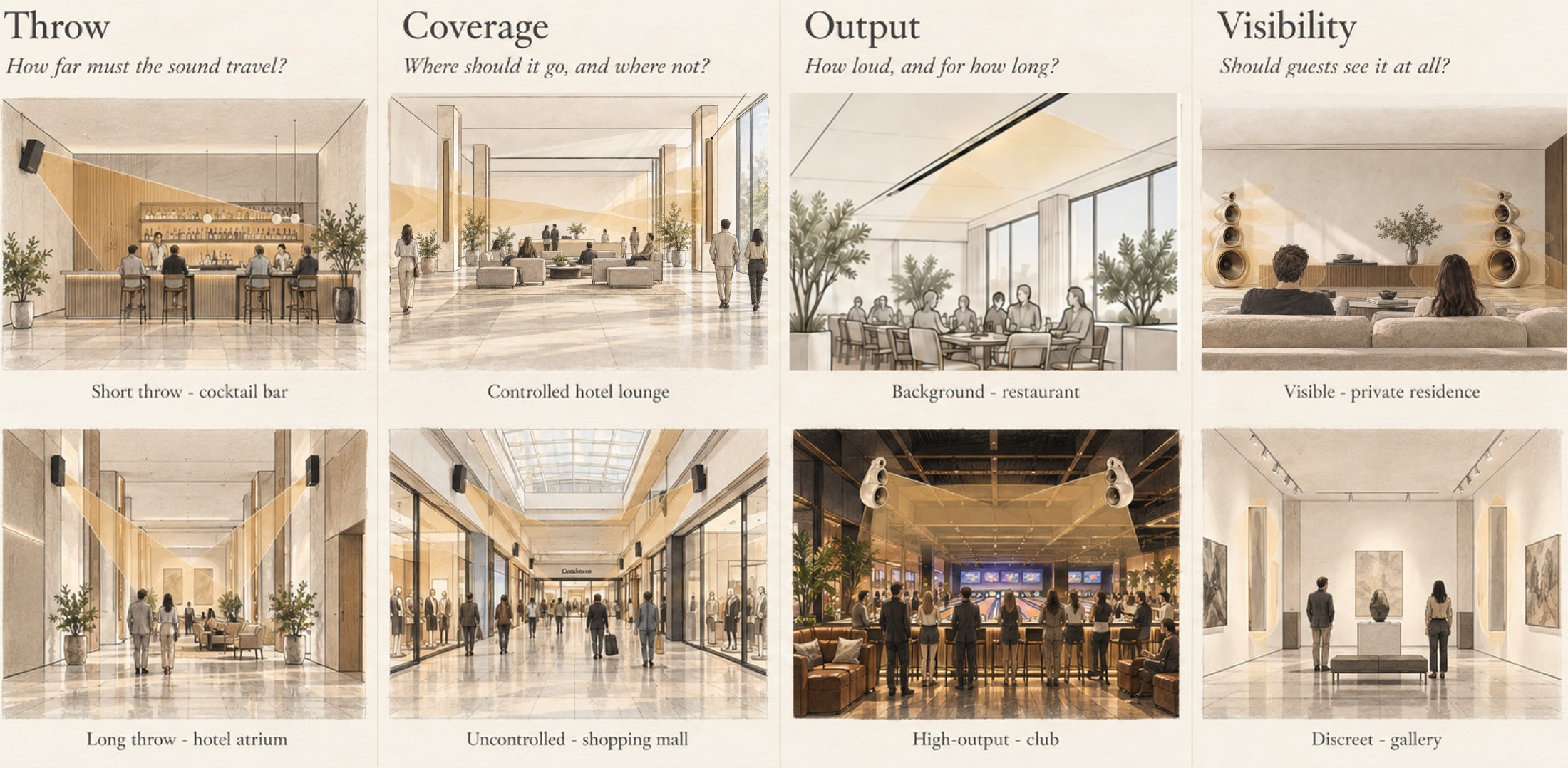
Start with the service rather than a speaker list. Agree the activities in each area, the intended musical character, staff controls and the practical limits of the room, then develop a system around those decisions.
Coverage Before Volume
One of the most common mistakes in restaurant audio is relying on too few speakers at too high a level. This often creates obvious hotspots, weak coverage in other areas, and rising vocal effort across the room as service builds.
A better approach is usually to create more even coverage using a greater number of carefully placed loudspeakers operating at lower levels. This allows the room to feel enveloped by sound rather than hit by it. Music remains present, but conversation stays easier and the space is less likely to tip into strain.
This is especially important in restaurants because the objective is rarely high impact playback. The objective is composure.
The Role of Zoning
A restaurant is not a single acoustic condition. The entrance, bar, main dining room, private dining room, washrooms and terrace may all need different treatment. The system should reflect that.
In practice, this means designing proper zoning from the start. Different areas need different levels, and sometimes different sources or tonal balances, depending on how the venue operates. A stronger atmosphere in the bar may be entirely appropriate while the dining room remains more restrained. A private room may need independent control. A terrace may need careful management of spill.
Good zoning allows a venue to feel joined up without sounding uniform.
Specify the system’s operating states
List the uses the venue actually needs: background playback, occupied dining, a private event, announcements or performance where relevant. For each state, agree sources, zones, level relationships, staff controls and the handover to the next use. These are operational design decisions, not proof of a commercial uplift.
One system. Several functions.
Illustrative venueAt concept design the venue is a plan: walls, openings and furniture. This is the point to design the audio, while ceilings, joinery and services can still move.
- Stage
- RIBA Stage 2
- Drawings
- Plan and furniture layout
The installed system: loudspeakers, integrated subwoofers and acoustic treatment, coordinated with the architecture. Every operating state that follows runs on this same equipment.
- Sources
- Playlist and DJ
- Routing
- Either source to any room
Music sets the character of the room without leading it. Even coverage and consistent level matter more than output.
- Source
- Scheduled playlist
- Preset
- Background
- Control
- Automatic
A private room separates for a dinner, launch or speech, then returns to service, without the team needing to touch the technical system.
- Source
- Playlist, private room independent
- Preset
- Event
- Control
- Private room panel
Where the brief calls for it, playback hands over to a DJ or live performer, with inputs, routing, monitoring and low-frequency support already designed in.
- Source
- DJ input, playlist off
- Preset
- Performance
- Control
- DJ or performer
Source
Active
Available, inactive
Speakers
Wall-mounted speaker
Integrated subwoofer
Bass trap
Coverage
Lower energyHigher energy
One system. Several functions.
Illustrative venueAt concept design the venue is a plan: walls, openings and furniture. This is the point to design the audio, while ceilings, joinery and services can still move.
- Stage
- RIBA Stage 2
- Drawings
- Plan and furniture layout
The installed system: loudspeakers, integrated subwoofers and acoustic treatment, coordinated with the architecture. Every operating state that follows runs on this same equipment.
- Sources
- Playlist and DJ
- Routing
- Either source to any room
Music sets the character of the room without leading it. Even coverage and consistent level matter more than output.
- Source
- Scheduled playlist
- Preset
- Background
- Control
- Automatic
A private room separates for a dinner, launch or speech, then returns to service, without the team needing to touch the technical system.
- Source
- Playlist, private room independent
- Preset
- Event
- Control
- Private room panel
Where the brief calls for it, playback hands over to a DJ or live performer, with inputs, routing, monitoring and low-frequency support already designed in.
- Source
- DJ input, playlist off
- Preset
- Performance
- Control
- DJ or performer
Source
Active
Available, inactive
Speakers
Wall-mounted speaker
Integrated subwoofer
Bass trap
Coverage
Lower energyHigher energy
Acoustics Cannot Be Ignored
Restaurant sound systems do not operate in isolation. The room itself has a major effect on how the system performs.
Hard floors, glazing, exposed ceilings, polished plaster and dense table layouts can all create acoustic conditions that push the room into stress as occupancy rises. Even a well designed system can struggle if the environment is too reflective. Likewise, a venue may blame the music system when the room itself is the main problem.
This is why restaurant sound design and restaurant acoustics are closely linked. The best outcomes come when both are considered together.
Architectural Integration

Selected work
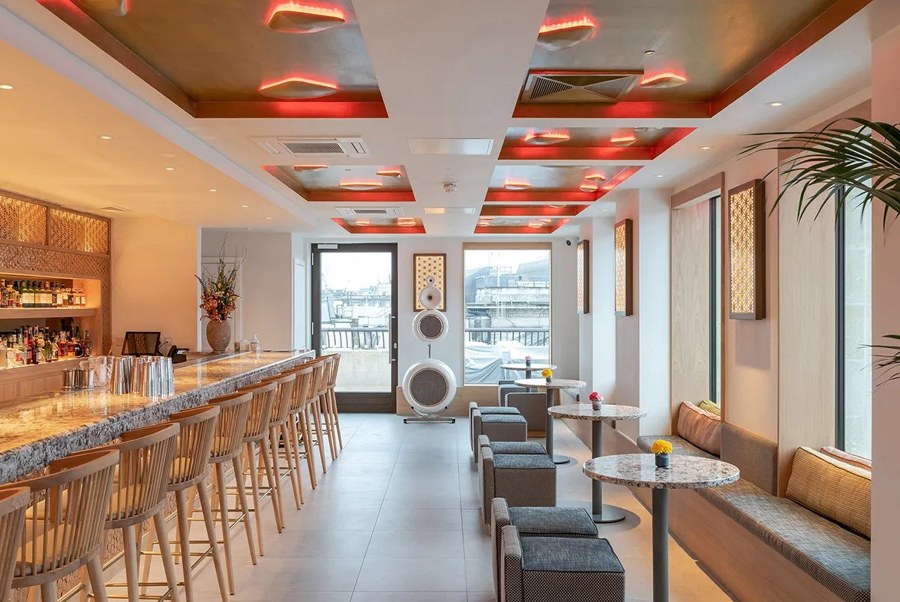
Bisushima
Architectural audio consultancy. Pequod Acoustics custom specification. Architecture by Ben Adams Architects.
As featured in Architecture Magazine
In premium restaurants, technology needs to be integrated with care. Ceiling plans are often tightly controlled. Decorative lighting, air conditioning, material transitions and joinery details all affect how audio can be resolved.
The system should sit comfortably within the architecture of the project. In some cases that means highly discreet loudspeakers. In others it may mean a more visible design led approach. What matters is that the audio feels intentional and does not undermine the visual quality of the room.
This is one reason specialist restaurant sound design is valuable. It allows the technical layer to be coordinated properly with the interior concept, which sits at the heart of our architectural audio consultancy.
Review low-frequency playback and transmission separately
Decide what low-frequency playback the musical brief needs and how it should be delivered in the room. Sound reaching neighbours or bedrooms is a separate assessment question. Do not describe system calibration, absorptive furniture or a preset alone as a verified sound-insulation solution.
Source: FIS (2021), Ceilings and Acoustic Absorbers, hosted by Rockfon
Reliability and Longevity
Restaurant systems are expected to work hard. They often run daily for long periods, and any problem quickly becomes operational rather than purely technical.
For that reason, restaurant systems should be designed around reliability, straightforward control and long term suitability. The venue should not need constant intervention to maintain the right atmosphere.


