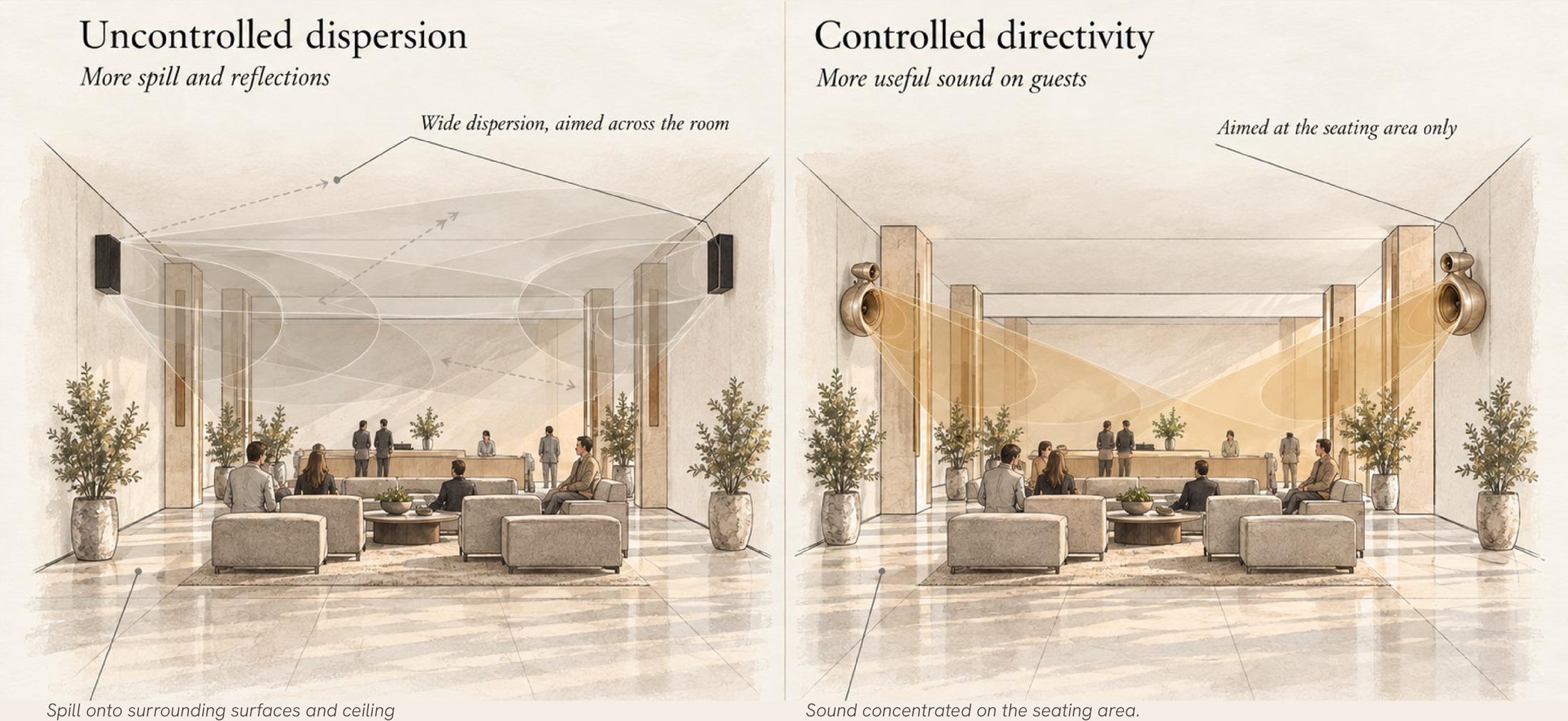
Room acoustics and sound system design address related but different questions. The operator needs to know whether the issue concerns the room, the way music is delivered, noise from equipment or transmission to neighbouring spaces.
What Is Restaurant Acoustics?
Acoustics refers to how sound behaves within a physical space. It is determined by architecture, geometry, and materials. Every surface in a restaurant either absorbs, reflects, or transmits sound energy, and the balance between these interactions defines the acoustic character of the room.
Hard surfaces such as concrete, glass, marble, and metal reflect sound waves. When a room is dominated by these materials, sound energy bounces repeatedly, creating reverberation, echo, and a buildup of ambient noise. Conversations become difficult. The room feels loud even when occupancy is modest.
Soft surfaces such as fabric, upholstery, curtains, and certain ceiling treatments absorb sound energy. They reduce reflections and help control the overall noise level. The challenge is integrating these materials in a way that supports the interior design rather than compromising it.
Acoustic design is the discipline of managing this balance. It considers ceiling heights, room proportions, surface finishes, and seating layouts to predict how sound will propagate and where problems might occur. In a well-designed space, sound remains controlled even as the room fills with guests.
Designing the delivery and operation of audio
System design concerns equipment, placement, source routing, processing and controls for the brief. Independent control of a private room does not make that room acoustically isolated. Where sound insulation, environmental noise or statutory reporting is required, coordinate with the relevant acoustic specialist. Visible equipment can be intentional, just as integration can be discreet.
Source: FIS (2021), Ceilings and Acoustic Absorbers, hosted by Rockfon
Why These Are Often Confused
The confusion arises because both acoustics and sound systems affect how a space sounds. When a restaurant feels uncomfortable, the instinct is often to blame the speakers. The assumption is that better equipment or higher volume will solve the problem.
In reality, the issue is frequently acoustic. A room with excessive reverberation will sound muddy and fatiguing regardless of how good the speakers are. The audio system is fighting against the room itself. Turning the volume up only makes matters worse.
Conversely, a room with excellent acoustics but a poorly designed sound system will still disappoint. Music will be uneven, conversations will be interrupted by sudden volume changes, and the atmosphere will feel inconsistent.
The two disciplines are complementary. Neither can fully compensate for failures in the other.
Establish which work is needed
Some problems concern playback delivery; others concern the room, operational sources or transmission. Do not assume that every venue needs all interventions. Diagnose the problem, agree the responsibilities and develop the system with the room’s actual constraints in view.
Source: Siebein and Siebein (2023), Restaurant Acoustics: A soundscape exploration and case studies
One system. Several functions.
Illustrative venueAt concept design the venue is a plan: walls, openings and furniture. This is the point to design the audio, while ceilings, joinery and services can still move.
- Stage
- RIBA Stage 2
- Drawings
- Plan and furniture layout
The installed system: loudspeakers, integrated subwoofers and acoustic treatment, coordinated with the architecture. Every operating state that follows runs on this same equipment.
- Sources
- Playlist and DJ
- Routing
- Either source to any room
Music sets the character of the room without leading it. Even coverage and consistent level matter more than output.
- Source
- Scheduled playlist
- Preset
- Background
- Control
- Automatic
A private room separates for a dinner, launch or speech, then returns to service, without the team needing to touch the technical system.
- Source
- Playlist, private room independent
- Preset
- Event
- Control
- Private room panel
Where the brief calls for it, playback hands over to a DJ or live performer, with inputs, routing, monitoring and low-frequency support already designed in.
- Source
- DJ input, playlist off
- Preset
- Performance
- Control
- DJ or performer
Source
Active
Available, inactive
Speakers
Wall-mounted speaker
Integrated subwoofer
Bass trap
Coverage
Lower energyHigher energy
What Happens When One Is Missing

Selected work
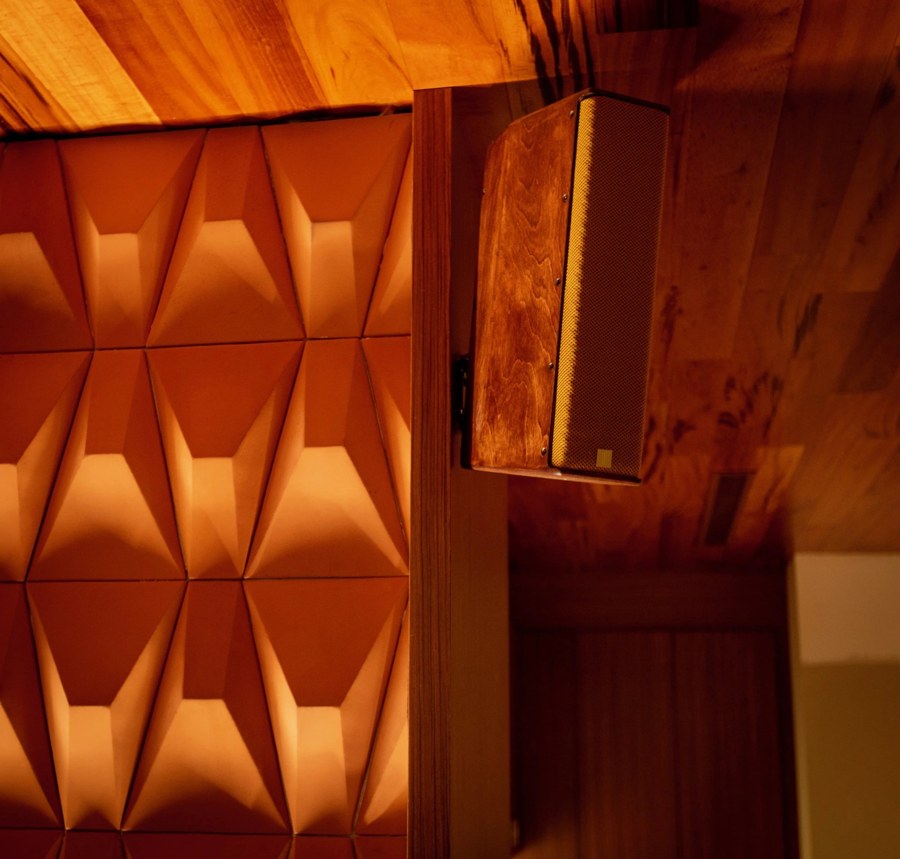
Claude's at Chotto Matte
Architectural audio consultancy. Custom loudspeaker integration. Interior design by Superfutures Design Studio.
As featured in Mondo-DR
Good Speakers, Bad Acoustics
This is the more common scenario. A venue invests in a high-quality sound system but ignores the acoustic environment. The result is a room that sounds loud, harsh, and fatiguing.
Music becomes indistinct as sound energy bounces off hard surfaces, conversations require effort and staff struggle to communicate, so the experience can feel uncomfortable without guests being able to say exactly why.
The speakers are not the problem. The room is.
Good Acoustics, Poor System Design
Less common but still problematic. A venue addresses acoustic treatment but installs a basic or poorly configured sound system. The room itself is comfortable, but the audio layer feels cheap, uneven, or intrusive.
Music is too loud in some areas and inaudible in others. Volume levels fluctuate as guests move through the space. The atmosphere lacks the polish that the interior design suggests.
The acoustics are not the problem. The system is.
How to Get It Right
The most effective approach is to address both acoustics and sound system design from the earliest stages of a project.
Concept Stage Planning
Acoustic and audio requirements should be defined during concept design, when ceiling plans are still flexible and material selections have not been finalised. This allows speaker positions to be integrated into the architecture and acoustic treatment to be coordinated with the interior design. For more on this topic, see our guide on whether you need an audio consultant for a restaurant.
Addressing these elements late means working with constraints. Positions become compromises. Treatment becomes a visible addition rather than an invisible layer. Systems become visible when they should disappear.
Collaboration With Architects and Designers
Sound should be treated as a design discipline, not a technical afterthought. Working with an audio consultant early in the process ensures that acoustic and system requirements are communicated clearly to the project team.
This collaborative approach protects the design intent while delivering functional performance. Speakers are concealed within ceiling systems. Acoustic panels are integrated into wall treatments. The technology supports the atmosphere rather than disrupting it.
Integrated Design Approach
The best results come from treating acoustics and sound systems as a single, integrated layer. The acoustic strategy informs speaker placement. The system design informs acoustic treatment priorities. Both are resolved together, in dialogue with the wider project.
This is how premium hospitality venues achieve environments that feel effortless. The sound is right, but the technology is invisible. Guests experience comfort and atmosphere without being aware of the mechanics behind it.
The Right Partner
At Sonic Design Studios, we provide restaurant sound system design in London that addresses both acoustic performance and audio system quality. We work with architects, interior designers, and operators to ensure sound is resolved properly from concept through to completion.
If you are planning a restaurant, bar, or hospitality venue, engaging specialist support early will protect atmosphere, comfort, and brand perception from day one.


