
A sound-level reading is useful only when its context is clear. For an operator, the practical questions include where the reading was taken, over what period, under what occupancy and whether staff exposure or guest experience is being assessed.
A number on its own means little
Decibels are easy to quote and easy to misread. The same room can give very different readings depending on where you stand, whether the place is half full or full, and whether the figure is a single snapshot or an average over time. A reading at the bar during service is not the same as one taken by an empty window at opening. So the first question is not "what is the number", it is "what does this number describe".
A reading needs a method and context
For any sound-level reading, record the metric, weighting, averaging period, measurement position, occupancy and operating state. A spot reading, a room average and staff exposure describe different questions. Avoid assigning every restaurant a universal comfortable or unacceptable band.
HSE workplace-noise action values concern daily or weekly personal exposure, not a dining-room comfort specification. Where staff exposure needs assessment, use an appropriate method and competent advice.
Source: HSE, Noise at work: employers
Exposure, comfort and compliance
UK workplace noise rules concern staff exposure over a working day or week. They are not a comfort target for a dining room, and a single sound-level reading is not a personal exposure assessment. Building regulations also have defined scopes: Approved Document E in England is not a specification for comfortable conversation in a restaurant.
Sources: HSE, Noise at work: employers. HSE · GOV.UK, Approved Document E. GOV.UK
Review the occupied venue
Compare representative service conditions rather than assuming an empty-room reading predicts peak operation. Note changes in voices, music and equipment. The review should consider the intended character of the venue and where people need to converse. There is no verified rule that a half-full restaurant at 65 decibels must become an 80-decibel room when full.
Source: Steffens, Wilczek and Weinzierl (2021), Junk Food or Haute Cuisine to the Ear?
How to take a reading that means something

Rather than aim for a published "comfortable" number, take a reading you can actually interpret:
- Note where in the room it was taken, and at what height.
- Measure over a representative period during a real service, not a single instant.
- Record how full the room was and what was happening, such as music, bar activity or an event.
- Be clear whether you are asking about staff exposure over a shift or guest comfort at a table, because they are different questions with different methods.
If your room already runs hot
If guests describe the room as too loud, the level can usually be brought down without flattening the atmosphere, by adding the right absorption in the right places and by designing the sound system, zoning and loudspeaker placement to suit it. Where the room needs formal acoustic design, that is the specialist acoustic consultant's work, and we coordinate with them.
Read more about hospitality, or book an Audio Strategy Review to find out how your room behaves in use.
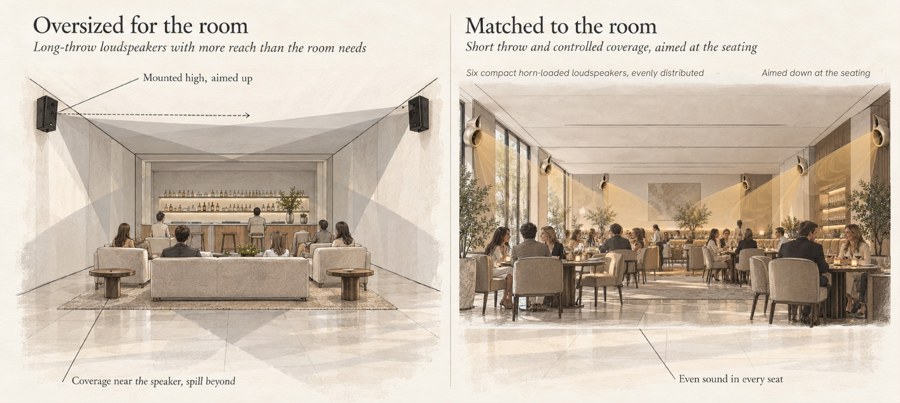
A reading is a starting point, not a verdict. In our hospitality work we read the occupied room and set the brief against how the space is actually used, as we did at Drunch, Riyadh.


