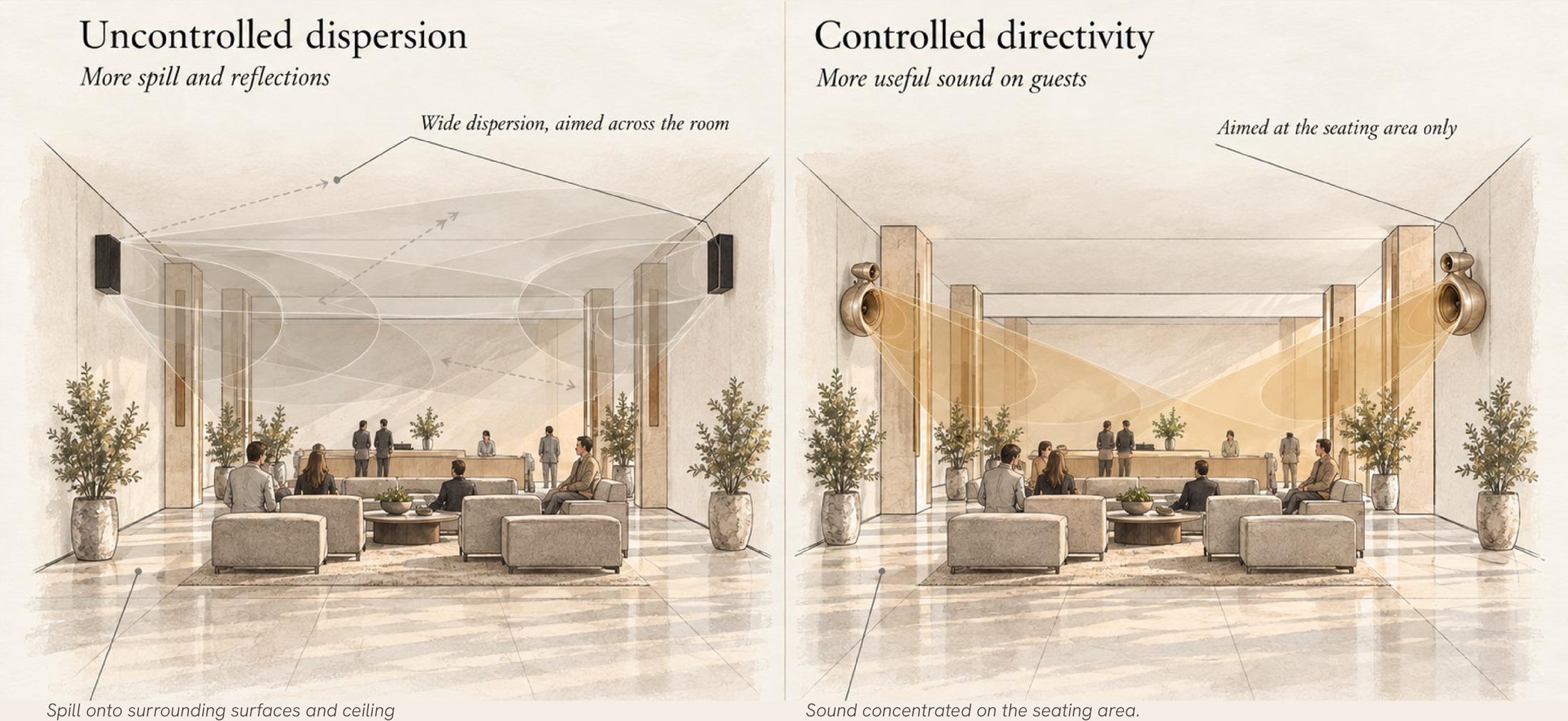
When guests struggle to hear one another, the first step is to identify what is contributing to the problem. Music, voices, equipment and the room itself may need different responses, so a useful review begins during a representative service.
Identify the sources and the room response
A loud dining room can involve conversation, music, equipment and sound arriving from elsewhere, as well as the way the room reflects it. Start with the location and service period in which difficulty occurs. The diagnosis should decide whether the next step belongs to operations, the audio system, room treatment or specialist transmission assessment.
Source: Siebein and Siebein (2023), Restaurant Acoustics: A soundscape exploration and case studies
One system. Several functions.
Illustrative venueAt concept design the venue is a plan: walls, openings and furniture. This is the point to design the audio, while ceilings, joinery and services can still move.
- Stage
- RIBA Stage 2
- Drawings
- Plan and furniture layout
The installed system: loudspeakers, integrated subwoofers and acoustic treatment, coordinated with the architecture. Every operating state that follows runs on this same equipment.
- Sources
- Playlist and DJ
- Routing
- Either source to any room
Music sets the character of the room without leading it. Even coverage and consistent level matter more than output.
- Source
- Scheduled playlist
- Preset
- Background
- Control
- Automatic
A private room separates for a dinner, launch or speech, then returns to service, without the team needing to touch the technical system.
- Source
- Playlist, private room independent
- Preset
- Event
- Control
- Private room panel
Where the brief calls for it, playback hands over to a DJ or live performer, with inputs, routing, monitoring and low-frequency support already designed in.
- Source
- DJ input, playlist off
- Preset
- Performance
- Control
- DJ or performer
Source
Active
Available, inactive
Speakers
Wall-mounted speaker
Integrated subwoofer
Bass trap
Coverage
Lower energyHigher energy
The volume spiral
As a room fills, this becomes self reinforcing. Guests cannot hear over the reflected noise, so they raise their voices. Raised voices add to the noise, so everyone raises their voices again. By peak service the room has climbed into a spiral it cannot escape, and turning the music down will not fix it, because the music was never the main problem.
The usual culprits
A few features reliably push a room over the edge: tall or exposed ceilings with no absorption overhead, large areas of glass and hard flooring, open kitchens that leak clatter into the dining room, and mechanical noise from ventilation that raises the baseline before a single guest arrives. Background music played loud enough to compete with all of this simply adds another layer to the spiral.
Treat complaints as a reason to investigate

Selected work
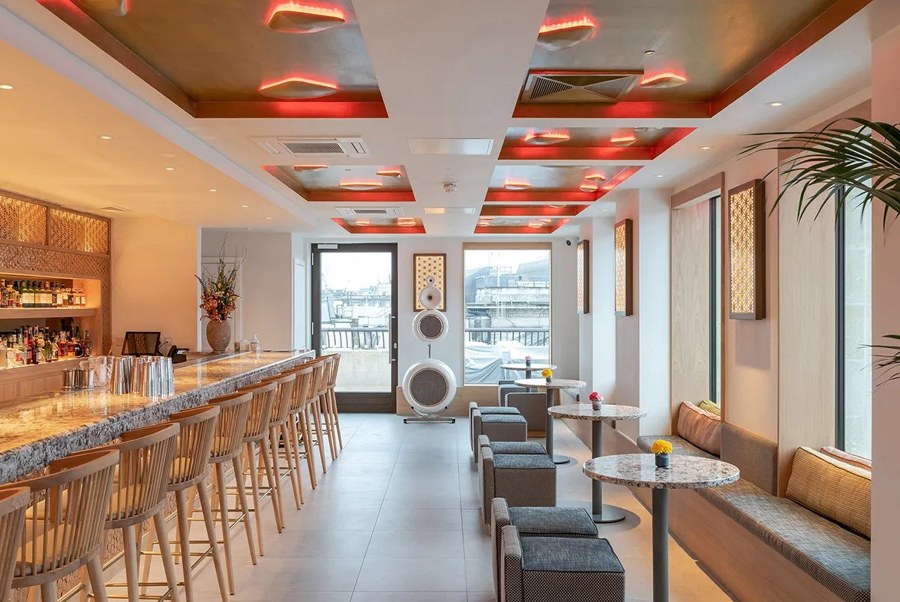
Claude's at Chotto Matte
Architectural audio consultancy. Custom loudspeaker integration. Interior design by Superfutures Design Studio.
As featured in Mondo-DR
Record what guests and staff report, where they report it and the conditions at the time. Use that evidence to define the review. Do not turn a complaint into an assumed lost bill or promise that a quieter room will increase spend. The practical goal is the listening and service experience the operator intends.
How to fix it
The fix is not to deaden the room, and it is not to bolt panels over a finished interior. It is to design absorption into the space so it does its work without anyone noticing. That means treating the largest reflective surface, usually the ceiling, deciding where energy should live and where calm should, zoning the room so the bar and the dining areas behave differently, and choosing finishes and soft elements that absorb sound while reading as part of the design. Done early, none of this compromises the look. Done late, it always shows.
If your room is already open and already loud, it can still be improved. But the most effective and the most invisible results come from designing acoustics in from the start.
Read about our approach to restaurant acoustic design, or book an Audio Strategy Review to identify the specific risks in your space.


