
The everyday sound of a venue includes music, conversation and the activity of service. Reviewing those layers helps the operator decide what should be prominent, what should be reduced and how the system should respond through the day.
Beyond Feature Moments
Many hospitality projects focus on statement environments. These are important, but they are episodic.
Guests spend far more time in:
- Arrival zones
- Circulation spaces
- Dining areas
- Lounges
- Guest rooms
If these spaces sound inconsistent, uneven, or fatigued, the overall perception of quality erodes.
Hospitality audio design must address the full spatial journey, not only headline moments.
Consistency Across Zones
Each zone carries its own behavioural intention.
Lobby: orientation and calm Restaurant: intimacy and clarity Bar: energy and density Wellness: restraint and softness
Without a defined sonic strategy, these transitions feel accidental.
A hospitality audio consultant defines:
- Level hierarchy across zones
- Tonal character appropriate to programme
- Coverage uniformity
- Operational simplicity
The result is consistency without monotony.
The character the operator intends
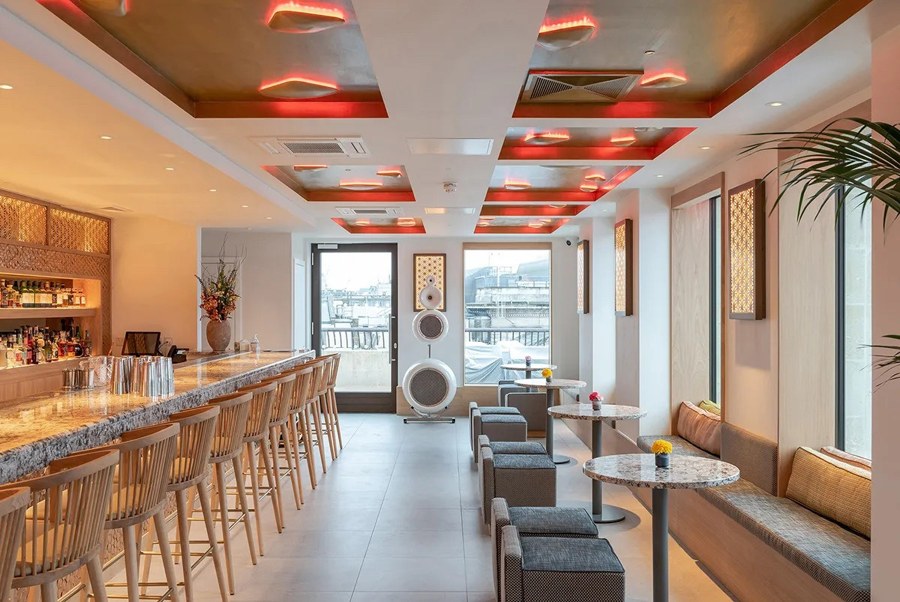
A venue may need restrained playback, foreground listening or a deliberate change in energy. Describe that specific purpose rather than a universal quiet-luxury style. Review how the system supports routine service, with equipment either visible or discreet according to the scheme.
One system. Several functions.
Illustrative venueAt concept design the venue is a plan: walls, openings and furniture. This is the point to design the audio, while ceilings, joinery and services can still move.
- Stage
- RIBA Stage 2
- Drawings
- Plan and furniture layout
The installed system: loudspeakers, integrated subwoofers and acoustic treatment, coordinated with the architecture. Every operating state that follows runs on this same equipment.
- Sources
- Playlist and DJ
- Routing
- Either source to any room
Music sets the character of the room without leading it. Even coverage and consistent level matter more than output.
- Source
- Scheduled playlist
- Preset
- Background
- Control
- Automatic
A private room separates for a dinner, launch or speech, then returns to service, without the team needing to touch the technical system.
- Source
- Playlist, private room independent
- Preset
- Event
- Control
- Private room panel
Where the brief calls for it, playback hands over to a DJ or live performer, with inputs, routing, monitoring and low-frequency support already designed in.
- Source
- DJ input, playlist off
- Preset
- Performance
- Control
- DJ or performer
Source
Active
Available, inactive
Speakers
Wall-mounted speaker
Integrated subwoofer
Bass trap
Coverage
Lower energyHigher energy
Portfolio Level Strategy
For hospitality groups, the challenge is not one building. It is coherence across multiple properties.
A portfolio sonic strategy defines:
- Brand character
- Zone standards
- Performance criteria
- Control logic
This ensures each property feels distinct yet recognisably aligned.
Without standards, each opening resets the learning curve.
Integration Without Visual Noise
Hospitality environments are material rich.
Stone, timber, brass, plaster, textiles. Audio hardware must respect this hierarchy.
Early audio strategy enables:
- Invisible integration
- Intentional sculptural expression where appropriate
- Reduced visual clutter
Late stage decisions introduce compromise.
Make routine use understandable

Agree staff permissions, normal settings, source handovers and a way to recover the intended state. Test the controls with the people who will use them and provide a practical handover. Reliability and clarity of operation are design objectives; do not attach an unmeasured financial benefit to them.
The Role of Consultancy
Hospitality audio design is not about selecting equipment first. It is about defining experience first.
An independent consultancy defines the sonic brief, coordinates with designers, and ensures integrators execute to performance criteria.
The objective is not spectacle. It is sustained quality.
Start With Strategy
If you are planning a new hotel, members club, or restaurant, defining the sonic layer at concept stage will protect brand character and reduce future friction.


